How a delivery company runs on BARITA.
Every run planned on one board. Proof for every delivery. Monthly bills that build themselves.
The setting: 22 vans and drivers, two shifts a day from one depot.
It started with one simple request.
“We are a delivery company with 22 vans delivering for online shops and local businesses. Every morning our dispatcher plans routes on a whiteboard and sends drivers their stops by a messaging app, customers call all day asking where their parcel is, and failed deliveries and proof of delivery are tracked on paper slips. …”
Read the whole request
We are a delivery company with 22 vans delivering for online shops and local businesses. Every morning our dispatcher plans routes on a whiteboard and sends drivers their stops by a messaging app, customers call all day asking where their parcel is, and failed deliveries and proof of delivery are tracked on paper slips. We also struggle to bill each business client correctly at the end of the month. I want to manage delivery orders from our clients, plan each driver's daily run, let drivers mark deliveries done or failed with a photo or signature from their phone, keep clients informed, and bill clients monthly, and see on-time rates and van utilisation.
What gets in the way.
Routes were planned on a whiteboard and sent to drivers as chat messages.
Customers called all day asking where their parcel is.
Failed deliveries and proof of delivery were tracked on paper slips.
Billing each business client correctly at month end was a struggle.
Watch the crew take it on.
We are a delivery company with 22 vans delivering for online shops and local businesses. Every morning our dispatcher plans routes on a whiteboard and sends drivers their stops by a messaging app, customers call all day asking where their parcel is, and failed deliveries and proof of delivery are tracked on paper slips. We also struggle to bill each business client correctly at the end of the month. I want to manage delivery orders from our clients, plan each driver's daily run, let drivers mark deliveries done or failed with a photo or signature from their phone, keep clients informed, and bill clients monthly, and see on-time rates and van utilisation.
The request as it was typed.
The requestPlan every run without the whiteboard
The work appears here
How each one is removed.
Routes were planned on a whiteboard and sent to drivers as chat messages.
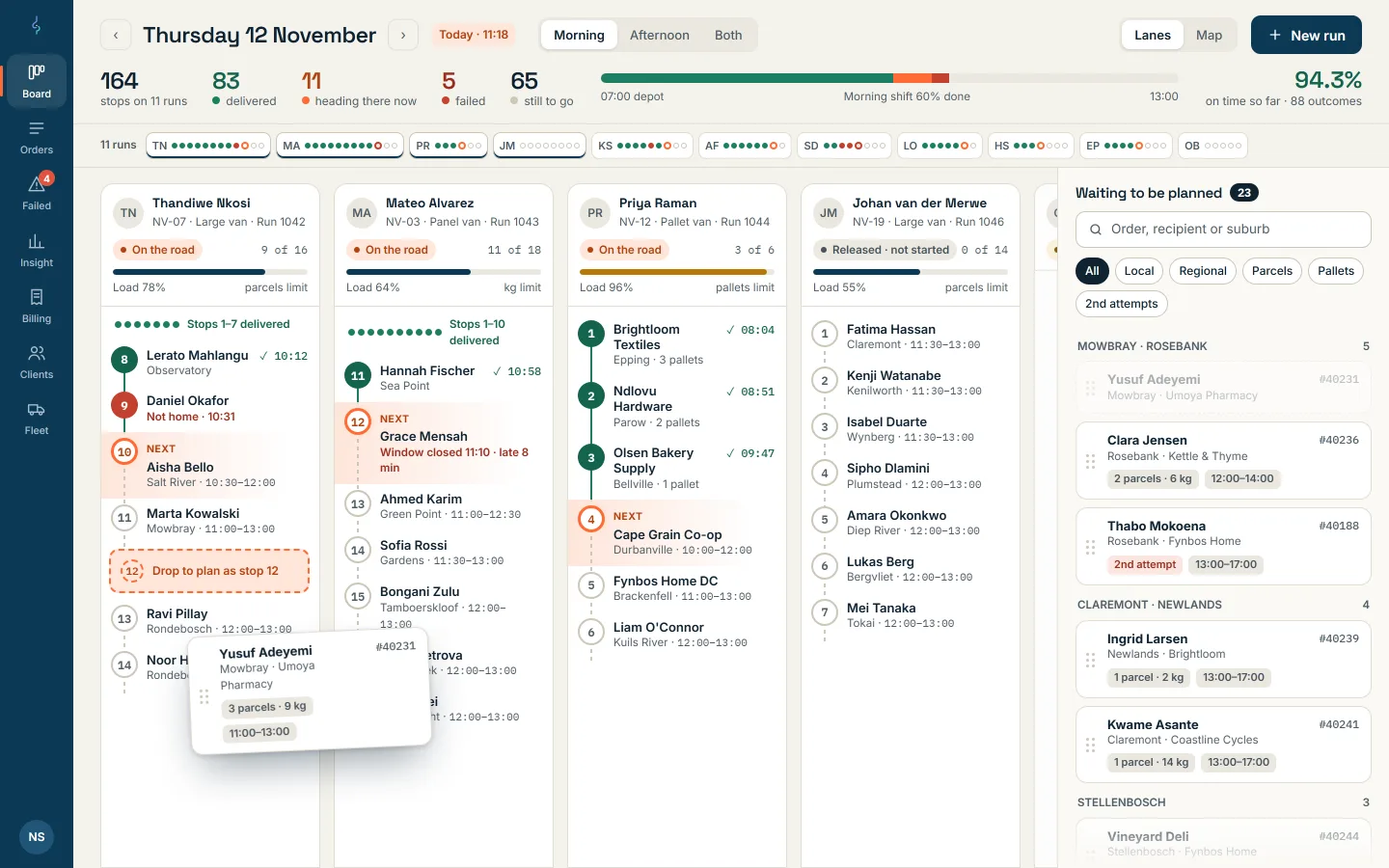
The dispatcher builds each driver's run on one board, and the driver sees the stops on the phone.
The app the crew designed
Customers called all day asking where their parcel is.
Each business client sees its own orders and their live status, with proof once delivered.
The app the crew designed
Failed deliveries and proof of delivery were tracked on paper slips.
Drivers mark each stop delivered or failed on the phone, with a photo, a signature or a reason.
The app the crew designed
Billing each business client correctly at month end was a struggle.
A monthly statement is built for each client from its deliveries and its own rates, ready to check.
A routine that runs by itself
What this takes off your plate.
The whiteboard comes down
Runs are planned on one board, and the dispatcher sees progress and van load as the shift goes on.
Fewer calls about parcels
Clients follow their own deliveries, and every delivery has a photo, a signature or a reason.
Month end becomes a check
Statements build from the deliveries and each client's rates, so billing is checked instead of pieced together.
Read next
Furniture workshop
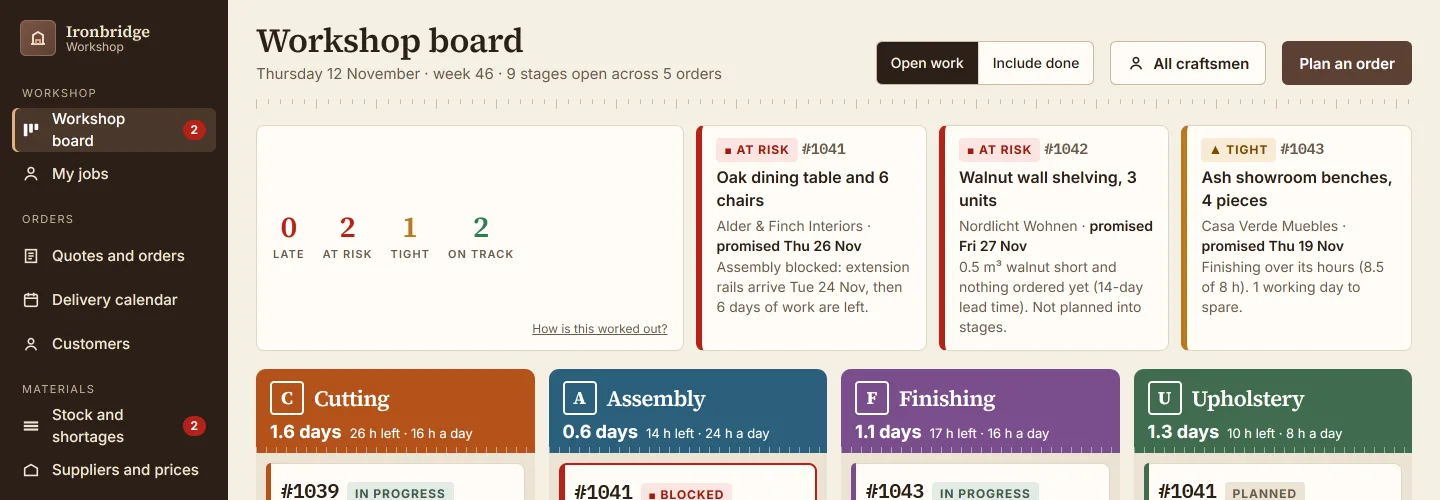
Promised dates are worked out from stock and booked work, and every order shows whether it makes money.
Orders tracked on a whiteboard meant dates that could not be kept and materials that ran out mid-job. The crew designed one workshop app from quote to delivery, with a board for the office and a tablet for the bench.
Your turn. One message is enough to start.
Say what your business needs in your own words. The crew plans it, shows you the screens, and builds once you agree.